Live Updates arrow
Account Login
search-icon
Close

New water connection

As part of your development or building works, you may need to connect to our water supply or change your existing water connection. Here, we’ll guide you through the process for applying for a water connection (Section 45).

background

You'll need to apply for a new water connection if:

  • you're building a property in a new location and need to connect to our network or you're renovating, changing the use of the property, or building an extension
  • you're converting a building into flats
  • you're installing an agricultural trough
  • you need a temporary water supply
  • you need to upgrade, replace or move your existing supply to increase the flow due to increased demand
  • you're looking to split into or from a shared supply within a commercial property
  • you need fire supplies.

You won't need to apply if:

  • you're splitting into or from a shared supply within a residential property
  • you’re replacing your private supply pipe due to pressure issues, or it's leaking
  • you're replacing your lead supply pipe
  • you do not have a meter and would like to request one. You can request a meter by calling 0330 303 0368.

How to apply for a new water connection

Below you can find useful documents to help you with your application. We'll be in touch every step of the way to make sure everything runs smoothly. Before you apply, you'll need: 

  • a site plan clearly showing your requested point of connection
  • a soil sample for any contaminated land
  • a location plan to give us a reference point to GIS)
  • your preferred point of connection. 
1

Apply online

Fill in our online form and pay your application fee using our GetConnected portal. We’ll review your application within five days. 

Apply now
2

Survey

We’ll carry out a survey on site to price up the water connection for your project within 28 days. 

3

Accept your quote

Review your water connection quote, accept and pay for the construction works. We'll also provide a water regulations questionnaire which you’ll need to complete. 

4

Water regulations review

We'll review your water fittings information within 10 days and grant your water regulations consent. For high-risk projects, we may need to carry out an inspection.
5

Lay your private supply pipe

After receiving your water regulations consent, you'll need to arrange for a qualified plumber or contractor to lay the private supply pipe from your property.
6

Inspect your private supply pipe

Once your private supply pipe is laid, you will need to contact us to book in a site inspection. We’ll inspect your pipework to make sure it’s ready to be connected to the water main. 

7

Provide the plot to postal

Before we connect your water supply, we need to match each plot on your site to its official postal address. This helps us set up your account and make sure everything is billed correctly. 

8

Submit your permit

If your water connection requires traffic management, we will need to submit for a permit which can take up to 3 months. Once this has been received the connection can be completed. 

9

Completion and meter install

Once we’ve connected you to our supply network, we’ll install a water meter. We’ll then send a letter asking the owner of the property or tenant to create an account to pay and manage their bills 

Useful guides and documents

Below you'll find specific documents and guidance to help you through the application process.

Showing 3 out of 3

Your questions answered...

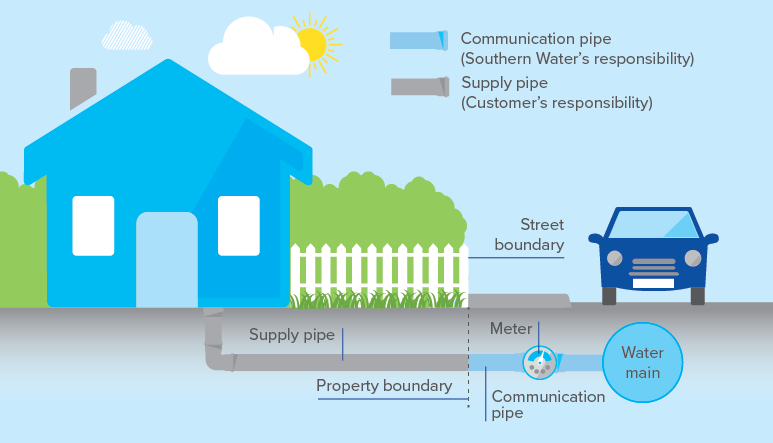
The below diagram is the typical layout of a property’s pipework and who’s responsible for what. You’ll be responsible for the private supply pipe which runs through your land up to the boundary of your property and any internal pipework. We own and maintain the large water mains and smaller communication pipes that run from the road as well as the water meter installed at the site boundary. 

We’ll make an assessment and let you know whether you need to disinfect your water supply. But as a rule, if your supply pipe is 63mm diameter (50mm internal diameter), or there’s reason to believe the pipework may be contaminated, then you must have it chlorinated and tested for microbiological content and turbidity by a UKAS accredited analytical laboratory. The results should be sent to us for approval two weeks prior to your water connection. 

The pipe must have a satisfactory pass before we can arrange your final connection. Please send the results to s45techqueries@southernwater.co.uk. 

Following the connection, your new water supply will be left live with a meter installed. From this point the occupier of the property will be responsible for the bill. They will need to register their account online, making sure they have their meter number to hand. 

Before the work takes place, please make sure any scaffolding has been removed so that our team has full access to the pipes. If you need to make plans so our team can safely access the site, please make these well in advance.  

Traffic management helps us work safely on the road. For most jobs, we can keep traffic moving or use two-way lights, and this is included in your standard water connection charge. If the work needs more complex traffic control or extra local authority fees, we’ll add an additional charge. 

Examples of where charges apply include:

  • 3 or 4-way temporary traffic lights when working at junctions
  • road closures
  • temporary closure of pedestrian crossings or traffic lights (often known as ‘bagging’ traffic lights)
  • lane rental charges. 

We may need to arrange highway licences to work in the road, which can take up to three months under the Highway Authority’s rules. If another utility company plans a closure on the same road, we’ll try to coordinate but their plans may not allow enough space for your water connection. To avoid delays, we recommend speaking with everyone involved early to find out what’s possible. 

A pipe is made redundant if it hasn’t been used for 60 days. Redundant pipes cannot be used because:

  • of issues with water quality as the water inside the pipe would have been stagnant which can cause harmful bacteria to growth and impact public health. We recommend flushing your water supply every seven days
  • the pipe may have been left open ended meaning it’s likely to be contaminated
  • the condition the pipe may be poor and not meet standards
    the pipe material may not be suitable (e.g. the ground may now be contaminated)
  • the pipe could be lead, negatively impacting water quality
  • the pipe may be in the wrong place
  • the pipe may not have the right diameter. 

If you have any questions, please contact us.  

If you need a new water supply for a trough in a field, you’ll need to apply for a water connection. You’ll also need to lay a private supply pipe across your land to the nearest water main — using our maps. There’s no need to apply for a sewer connection, as troughs don’t produce wastewater. You can also supply a trough from an existing metered supply, such as a farmhouse connection, but it can’t be billed separately. 

Only our teams or approved contractors can work on our network. Using anyone else such as contractors who have not been approved is against the law and could lead to prosecution under the Water Act. For more information on approved contractors please visit our self-lay page. WIRS-accredited self-lay organisations may carry out certain connection and supply works, depending on their accreditation level. 

Sewer infrastructure charges cover the extra demand your connection places on our network. Larger meters can draw more water, so the network must be designed and maintained to handle that capacity. These charges reflect the impact on our infrastructure and the investment needed to keep a reliable wastewater service for everyone. Sewer infrastructure charges will be included in your water connection quote if you’re connecting to the sewerage system. 

If your private supply pipe crosses someone else’s land, please get written consent from the landowner and upload it with your application through the GetConnected portal. This confirms the pipe was laid legally. You can include this along with your other supporting documents. 

If your development is on land that may be contaminated, you’ll need to provide a Soil Analysis Report with your water connection application. This applies to new builds, renovations, or conversions. If your site was previously used for things that could cause contamination, sending us a soil analysis early can help avoid the cost of installing barrier pipe. 

 Examples include:  

  • Petrol Station.
  • Fuel Storage.
  • Motor Mechanics.
  • Vehicle Parking Boatyard.
  • Military Camp.
  • Coal Yard.
  • Chemical Storage Scrap Yard.
  • Landfill.
  • Burial Ground.

Please submit your soil analysis report as a supporting document to your new water connection application via the GetConnected portal. Learn more about contaminated land.

Please let us know if you need any existing water supplies disconnected, we can provide you with a quote to complete this as part of your job. The last meter reading will be taken, and the final bill will be sent to the billpayer.