


Why we need the Southampton Link Main
The South East is officially classed as water-stressed due to the need to leave more water in the environment, coupled with a growing population and changing climate. Hampshire relies heavily on the environment for drinking water, with most of it coming from underground and the rest from sensitive chalk stream rivers, like the River Test and River Itchen. New environmental limits mean we must reduce the amount of water we take from these rivers, especially during a drought.
We’re transforming the way we source, treat and supply water across Hampshire. Creating a new, resilient, and sustainable water supply will protect and enhance the county’s rare and sensitive chalk streams, while maintaining supplies for our communities and the local economy.
We’re investing millions in a range of solutions:
- Developing new sources of water – including water recycling to keep treated water within our network.
- Building a network of new pipelines to link up our key sites and allow additional transfers of water from neighbouring water companies.
- Teaming up with Portsmouth Water to build a new reservoir at Havant Thicket to be used as a strategic water resource for the South East.
These are all part of our 'Water for Life – Hampshire’ programme, which addresses the county’s water shortfall.
About the project
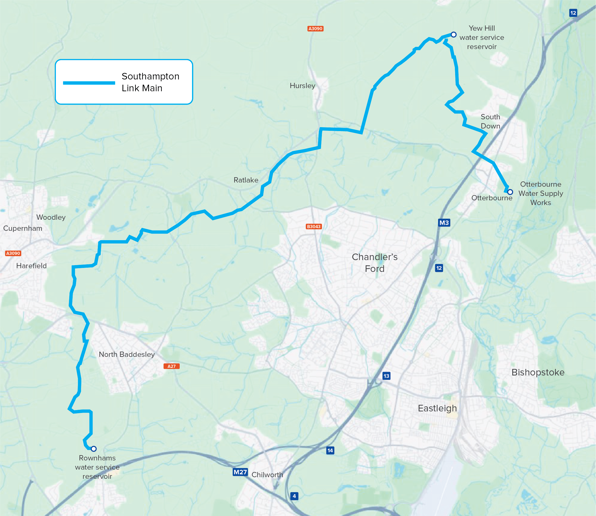
We are building a network of new pipelines to link up our key sites and allow additional transfers of water from neighbouring water companies. The Southampton Link Main is one of these pipelines. Moving water around our network will help make it more resilient and means we can take less water from the River Test and River Itchen.
Once complete, the Southampton Link Main will improve resilience by reducing the impact of burst pipes, mechanical failures, or sudden increases in demand. So, if there was a problem at one of our sites, we can use one of the others to keep people supplied with drinking water.
The pipeline will run underground between our Otterbourne Supply Works and the Yew Hill underground reservoir near Winchester. From Yew Hill, it will continue south to Rownhams, where another underground reservoir supports the wider water network. We are also increasing the capacity of Yew Hill Reservoir to support long-term demand and improve network resilience.
The route has been carefully selected using insights from landowners, residents and businesses, along with detailed environmental and ecological information, surveys and assessments.