
Live Updates arrow
Account Login
search-icon
Close

Developing our DWMP

We’re working with a wide range of stakeholders to develop our DWMP as we continue to protect communities and the environment from flooding and pollution. We’ll update these pages as we progress towards the formal public consultation in late 2027.

background

Partnerships and collaborations

We are committed to developing this plan in partnership with local planning authorities, flooding and land drainage authorities, catchment partnerships, environmental organisations and our regulators. Collaboration with environmental organisations to develop opportunities to deliver greener, nature-based and sustainable solutions that benefit our customers, communities and the environment is at the heart of our plan. 


Independent oversight

An Independent Regional Advisory Panel oversees the development of our plan at all stages to ensure we will meet the statutory requirements of the guidance, the needs of our customers and the environment. 

The DWMP planning is an ongoing process, incorporating major capital improvements, new housing development, changes to legislation or regulatory guidance, or new information on environmental water quality published by the Environment Agency or catchment partnerships. We’ll consult on our preferred plan once it is completed.

  1. Strategic Context
    The Strategic Context analyses the trends and development that are likely to negatively or positively affect our wastewater systems, now and in the future.

  2. Risk-based planning
    The risk-based planning stage is where we evaluate the current risks within each wastewater system, identify how the trends will affect the performance of our assets, and whether the risks need to be addressed in the short, medium or long term. Risks that overlap with the responsibilities of other organisations will be identified.

  3. Options Development and Appraisal
    During the Options Development and Appraisal stage, we will work with relevant partner organisations to identify all possible options to reduce the risks in each system, evaluate the associated costs and benefits and determine which will provide the best possible value for our customers, communities and the environment. 

  4. Preferred plan
    Our preferred plan comprises the best value interventions identified for each of our wastewater systems across our entire region. 

  5. Reporting and consultation
    A public consultation will be held on the draft version of our preferred plan, followed by a final plan incorporating the feedback received. Each year, we will publish an Annual Review of our plan to report on progress.   
Our timetable

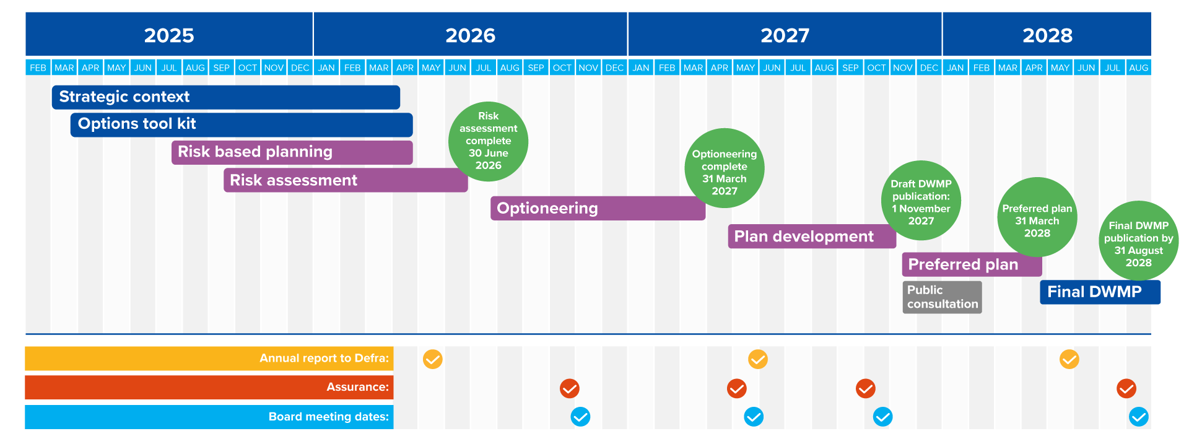
Our timetable to deliver the DWMP is:

DWMP Timetable 2026


Future trends and challenges

We’ve been looking into the future trends and challenges that could affect our operations and wastewater infrastructure so we can adapt and future-proof our business to meet the needs of a changing world.   

We are already seeing greater intensity and frequency of:   

  • Temperatures and heatwaves – increasing temperature will impact on the biological processes at both our wastewater treatment works and in rivers. This may result in waterbodies becoming more vulnerable.   
  • Rainfall and storminess – heavier rainfall means it will be increasingly more challenging to effectively drain it away, which can lead to increased surface water and sewer flooding.
  • Drought – water shortages will affect the flow in our rivers and can mean they are at increased risk of ecological harm.
  • Sea level rise – our coastal infrastructure is likely to be at increased risk from coastal erosion and from salty groundwater getting into the sewers, reducing sewer capacity, corroding pipes and impacting on our treatment processes.    

The Southeast is expected to have the highest levels of population growth in the UK. We expect a further 800,000 people to be living and working here by 2040. We will need to plan for our wastewater systems to accommodate this growth. 

Urban creep is when families choose to extend their houses rather than move. We expect this to be an increasing problem for us, as it often means an increase in rainfall from larger roofs and hardstanding ending up in our sewers.  

We will work with communities to promote green, sustainable drainage systems to minimise rainwater entering the drains. 

A high-quality water environment is fundamental to supporting local tourism, shellfisheries and recreation. Only 14 – 15% of inland waterbodies in England are currently assessed as having a “good” standard.  

Ever stricter and increasingly ambitious effluent standards for our treatment works and overflows are likely to be required in future to tackle these challenges from persistent chemicals, pharmaceuticals, microplastics and key environmental nutrients, such as Nitrogen and Phosphorus.    

We expect good quality bathing water to continue to be important to our customers. We have seen a rise in popularity of wild open water swimming and recreational pursuits and a pressure to designate inland waters as bathing waters. Significant investment will be required to achieve bathing water standards inland 

Technology will not remain static. We expect to be helped in meeting these future challenges using technology we don’t yet know about. We have already embraced several new developments in recent years.  

We have invested significantly in our artificial intelligence (AI) and monitoring capability. We now use these systems to proactively clean sewers with high pressure water jets to disperse potential future blockages before they are an issue.  

Membrane Bioreactor technology replaces gravity settlement in some of our wastewater treatment systems, using high efficiency ultrafiltration membranes that can separate tiny particles including bacteria, to a much higher level. We expect this technology will help meet tighter future standards.  

We anticipate that changes in personal vehicle use may change the nature of road use. Heavier vehicles, due to battery weight, may generate higher levels of micro-plastics and chemicals that could end up in our sewers and need effective treatment in drainage networks.  

A switch to greater autonomous vehicle use and shared ownership may see a fundamental shift in how we use our roads, which may create an opportunity to redesign road infrastructure around Sustainable Drainage Systems (SUDS) to keep rainwater out of sewers.  

Our carbon reduction plan is working towards our operations being carbon neutral by 2050. We are committed to pursuing nature-based solutions to support a more sustainable future.