
Live Updates arrow
Account Login
search-icon
Close

About the DWMP

Our DWMP identifies the improvements and investments needed for our wastewater systems and services up to 2055 across Kent, Sussex, Hampshire and the Isle of Wight.

background

Our DWMP

Our DWMP identifies the improvements and investments needed for our wastewater systems and services up to 2055 across Kent, Sussex, Hampshire and the Isle of Wight. It looks 25 years ahead and outlines how we plan to improve, maintain and manage our 372 drainage and sewer systems so they are safe, reliable and ready to deal with the impacts of climate change and population growth. 

Our DWMP considers the recent and forecast performance of our wastewater systems and what investment is needed to meet the expectations of our customers and the needs of the environment.    

Our plan considers future trends, such as population growth and climate change, and the actions we intend to take to reduce the risk to our systems from these trends. We also look at how technological advances might create opportunities for our wastewater operations, management and treatment processes. Take a look at future trends and our Strategic Context.

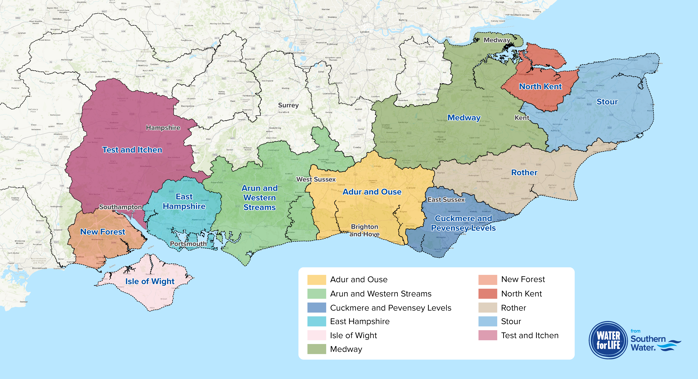
The DWMP uses three geographic boundaries for reporting. These are:

  • The whole of the Southern Water region
  • River Basin Management Catchments
  • Wastewater system boundaries


Some of our wastewater systems cross regional boundaries into neighbouring water company areas. We’ve included all the assets that we own in these cross-border locations into the nearest river basin catchment for the purposes of reporting on our DWMP. 

Some of our wastewater system boundaries extend into neighbouring river basin catchments, so we’ve assigned the wastewater system according to the waterbody into which are continuous discharges are released. 

Our maps and boundaries can be found on our interactive mapping portal.
Our statutory responsibilities 

Producing a DWMP is now a statutory requirement. Defra guidance, published in May 2025, provides information about the DWMP and how to produce it.

Our statutory obligations set out in the Water Industry Act 1991, includes addressing: 

  • the capacity of our drainage and sewerage systems
  • an assessment of the current and future demands on our drainage and sewerage systems
  • the resilience of our drainage and sewerage systems
  • the measures we intend to take or continue for the purpose of meeting our statutory obligations
  • the likely sequence and timing for implementing those measures
  • relevant environmental risks and how those risks are to be mitigated
  • any other matters specified in directions. 


The Defra DWMP guidance states that our DWMP must align with the Statutory Plans produced by others. This includes: 

  • Flood Risk Management Plans, produced by the Environment Agency (EA) and Local Flood Risk Management Strategies and Surface Water Management Plans, produced by the Lead Local Flood Authorities
  • River Basin Management Plans, produced by the EA
  • The Storm Overflows Discharge Reduction Plan produced by Defra (the Department for the Environment, Food and Rural Affairs)  
  • Local Development Plans, produced by the Local Planning Authorities
  • Spatial Development Strategies, produced by County and Unitary Authorities
  • Local Nature Recovery Strategies, produced by County Councils and Unitary Authorities
  • Water Industry National Environment Programme (WINEP) and the Water Industry Strategic Environment Programme (WISER), produced by Defra, the EA and Natural England.    

The Water (Special Measures) Act introduced the additional requirement to consider the use of nature-based solutions, technologies and facilities within our drainage and sewerage systems. 

Within Southern Water, we have programmes that are closely linked with the DWMP, including our:

Clean Rivers and Seas Plan
Pollution Incident Reduction Programme
Environmental Performance Reporting
Net Zero Goal

A regional plan

This will summarise:

  • The scope and strategic objectives for the DWMP
  • How the plan has been developed through collaboration, which partner organisations were involved and how they contributed
  • The options development and the assessment of criteria, benefits and constraints
  • A summary of our Strategic Environmental Assessment
  • Details of planned major investment projects
  • The overall benefits and costs of the plan 

An investment plan for each of our 11 River Basin Management Catchments

This will set out:

  • The risks to and from our wastewater systems
  • Future trends and how these will positively or negatively affect these risks
  • How we have worked with partner organisations and the way they have contributed to our DWMP
  • The options considered to address the risks and the assessment criteria for those considered
  • A summary of the overall benefits and investment costs to ourselves and partner organisations
  • Major investment projects and likely positive and negative impacts 

Interactive mapping systems

This will set out:

  • The boundaries of each of the River Basin Management Catchments
  • Major land uses and land use changes, where known
  • Location of proposed major investment into our drainage and wastewater system
  • Discharges that will fail to meet discharge criteria or that pose a risk to river quality, bathing or shellfish waters
  • Areas where action is required, for example, to disconnect surface water from our sewers
  • Opportunities for nature recovery and Biodiversity Net Gain
  • Sites with statutory protections, such as Sites of Special Scientific Interest


Data Tables

These will capture the key metrics and costs of the proposed solutions to address identified risks.


Strategic Environmental Assessment

This will include a scoping document, public consultation and Statement of Response.


A Statement of Response to the public consultation

This will show how we have responded to the representations received, the changes we have made or not made as a result with our reasons for making any changes. 


A Statement of Assurance

This is from our board to the Secretary of State for the Environment showing that we have met our statutory obligations, that the plan provides best value, is based on sound and robust evidence, including the costs, and that we are able to meet and continue to meet our obligations under the Water Industry Act 1991.  

The statement must be accompanied by detail of how the board has engaged, overseen and scrutinised all stages of development of our plan and the evidence it has considered in giving its assurance statement. 

Our region-wide plan will be published in draft for a formal public consultation in November 2027 and a final plan will be published before the end of August 2028. This DWMP will directly inform the next five-year Business Plan covering the period 2030–35.  

The plan will be regularly reviewed and updated. Each year we will send a statement of the conclusions of an annual review to the Defra Minister, and our environmental and economic regulators. The Regional Plan will be reviewed and republished every five years.  

A Business Plan is submitted to Ofwat, the water industry economic regulator, at each Price Review, covering the next 5-year investment planning cycle, known as the Asset Management Plan (AMP). Our DWMP published in August 2028 will provide the data and evidence for the Price Review submission for AMP9 from 2030 to 2035.